
In the yoga wear manufacturing process, many activewear brands are familiar with the terms “pattern making” or “pattern development.” Whether development yoga leggings, sports bras, workout tops, or full yoga wear sets, pattern development is one of the most important steps before a product moves from design concept to actual production.
So, what exactly is a yoga wear pattern? Why does it directly affect the fit, comfort, support, and performance of the finished garment? And how does a professional pattern maker decelop a new yoga wear style step by step?
In this article, we will explain the complete yoga wear pattern development process from the perspective of a professional yoga wear manufacturer, helping brands better understand how a high-quality yoga garment is transformed from a design idea into a finished product.
What Is a Yoga Wear Pattern? The Foundation of Fit in Yoga Wear Manufacturing
A pattern can be understood as the “structural blueprint” or “cutting template” of a garment.
A yoga garment is not simply made by cutting fabric according to a picture and sewing it together. Before production begins, the pattern maker needs to create the structure of each fabric panel based on the design sketch, tech pack, reference sample, size chart, body structure, and fabric stretch.
Differences Between Yoga Leggings Patterns, Sports Bra Patterns, and Workout Top Patterns
For example, a pair of professional yoga leggings usually includes multiple components such as the front panel, back panel, waistband, crotch structure, side seams, inseams, panel lines, and leg opening. The shape, angle, measurement, and proportion of each pattern piece directly affect the final fit of the garment.
A sports bra pattern focuses more on bust coverage, underband support, strap angle, back tension, and padding space. A workout top pattern needs to consider the shoulder line, armhole, body length, hem, neckline, and overall freedom of movement.
Why Does a Yoga Wear Pattern Affect Garment Quality?
For close-fitting, high-stretch, performance-focused products such as yoga wear, pattern development is especially important. Yoga wear must not only fit the body closely, but also provide stretch, support, compression, flexibility, and comfort.
If the pattern is not professionally developed, even high-quality fabric may result in problems such as waistband pressure, crotch discomfort, wrinkles, bulging, excessive compression, poor fit, or an unstable silhouette.
Therefore, in professional yoga wear production, pattern development is one of the core factors that determine product quality.
What Information Is Needed Before Yoga Wear Pattern Development?
Before a pattern maker starts developing the pattern, the factory usually needs to confirm complete product development information with the client. The clearer the information is at the beginning, the more efficient and accurate the sample development process will be.
1. Yoga Wear Design Materials: Sketches, Tech Packs, and Reference Samples
Clients may provide design sketches, tech packs, reference images, or physical reference samples. Based on these materials, the pattern maker analyzes the overall structure, including neckline shape, strap design, waistband height, length proportion, panel line position, pocket structure, zipper placement, and hem finishing.
For yoga wear OEM/ODM customization, design materials are the foundation of pattern development. The more complete the design information is, the more accurately the factory can understand the desired fit, structure, and product style.
2. Yoga Wear Size Specifications: Sample Size and Brand Size Chart
Different brands serve different target markets, and size standards may vary. For example, European, American, Asian, and Australian markets may differ in height, body shape, and wearing preferences.
The pattern maker needs to confirm the sample size and key measurements according to the client’s size chart, such as bust, underbust, waist, hip, thigh, inseam, outseam, shoulder width, sleeve length, and body length.
If the client does not have a complete size chart, a professional yoga wear manufacturer can also help estabilish a basic specification based on the brand positioning, target market, and reference sample.
3. Yoga Wear Fabric Performance: Stretch, GSM, Recovery, and Compression
Yoga wear fabrics usually have strong elasticity, such as nylon spandex, polyester spandex, or organic cotton spandex blends. Different fabrics vary in horizontal stretch, vertical stretch, recovery, GSM, thickness, compression, and hand feel.
Pattern development cannot rely only on measurement data. It must also take fabric performance into consideration.
For example, fabrics with higher stretch usually require more precise control of negative ease to ensure the garment fits the body without causing excessive pressure. Fabrics with lower stretch or heavier GSM may require more allowance in the pattern structure to provide better comfort and mobility.
4. Yoga Wear Fit Goal: High Compression, Light Compression, Sculpting, or Athleisure Fit
Before developing a yoga wear sample, the client should also confirm the intended wearing effect.
For example, is the product designed for high-compression training, light-compression daily wear, body sculpting, or relaxed athleisure styling? Is it intended for yoga, Pilates, gym training, or everyday lifestyle wear?
Different product positioning requires different pattern ease, structural proportions, support design, and fabric selection.
Yoga Wear Pattern Structure Analysis: Turning a Design into a Production Ready Pattern
After confirming the design materials, size chart, and fabric information, the pattern maker begins the structural analysis.
The purpose of this stage is to translate the client’s design sketch or reference sample into a flat pattern structure that can be cut and sewn in production.
Yoga Leggings Pattern Structure Analysis: Waistband, Hip Fit, Crotch Curve, and Length Proportion
For yoga leggings, the pattern maker needs to analyze the relationship between the front panel, back panel, waistband, crotch curve, side seam, inseam, knee position, and leg opening.
The pattern maker evaluates whether the waistband is stable, whether the hip area fits properly, whether the crotch is comfortable, whether the thigh measurement is appropriate, and whether the knee position affects movement.
Sports Bra Pattern Structure Analysus: Support, Strap Angle, and Padding Space
For sports bras, the pattern maker focuses on bust coverage, underband support, strap angle, back tension, padding space, lining structure, and ease of wearing.
If the pattern structure is not correct, the garment may have issues such as gaping cups, shoulder pressure, lack of support, underband riding up, uneven compression, even if the measurements appear correct.
Therefore, pattern development is not simply copying an image. It requires the pattern maker to combine body structure, movement needs, fabric performance, and production techniques to create a reasonable, stable, and scalable garment structure.
Yoga Wear CAD Pattern Making: Building a Professional Base Pattern
After structural analysis, the pattern maker starts drawing the pattern.
Today, professional garment factories usually use CAD systems for digital pattern development. Compared with traditional manual pattern making, digital pattern making offers higher measurement accuracy, faster modification, easier data storage, smoother grading, and better connection with bulk production.
Key Points in Yoga Leggings CAD Pattern Making
A yoga leggings pattern usually includes the waistline, hip line, crotch curve, side seam, inseam, knee line, and leg opening.
The pattern maker needs to control waistband height, hip coverage, crotch curve, and leg proportion according to body curves, fabric stretch, and the desired fit.
Key Points in Sports Bra CAD Pattern Making
A sports bra pattern includes the bust line, underband line, strap line, armhole, back structure, and lining structure.
For Medium- to high-support sports bras, special attention must be paid to underband support, strap tension, and bust stability to avoid insufficient support or uneven pressure during wear.
Negative Ease Control in Yoga Wear Patterns
For yoga wear, negative ease control is especially important. Because yoga wear fabrics are elastic, the garment measurements are usually smaller than the actual body measurements. The fabric stretch creates close fit, support, and compression.
If the begative ease is too strong, the garment may create excessive pressure. If the negative ease is insufficient, the garment may lose its shaping effect and movement stability.
Therefore, negative ease control is one of the most experience-driven and technical parts of yoga wear pattern development.
Yoga Wear Pattern Seam Allowance and COnstruction Planning: Ensuring Stable Sampling and Bulk Production
A professional pattern must not only achieve the desired fit, but also work well with actual production techniques.
When drawing the pattern, the pattern maker needs to add seam allowance according to different sewing methods and consider how construction affects garment measurements and fit.
How Sewing Techniques Affect Yoga Wear Patterns
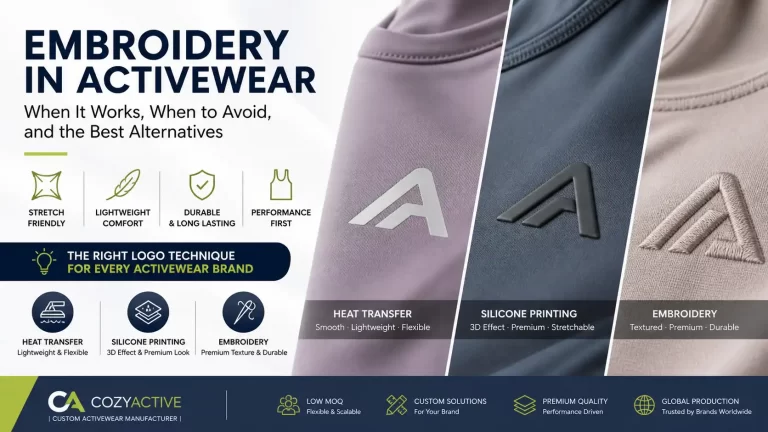
For example, flatlock stitching, overlock stitching, binding, coverstitching, panel seams, zipper, patch pockets, heat-transfer logos, and embroidered logos can all affect the pattern structure.
If the product requires additional support, such as a sports bra underband, yoga leggings waistband, double-layer lower abdomen panel, or interal power mesh support, the pattern maker also needs to reserve the correct space in the structure.
How Pattern Development Improves Yoga Wear Bulk Production Stability
The pattern also needs to consider production stability. A good pattern should not only fit well in the first sample, but also be suitable for bulk production, reducing risks such as sewing difficulty, unstable measurements, or inconsistent garment appearance.
This is why a professional yoga wear manufacturer considers design effect, body structure, fabric performance, and production feasibility during the pattern development stage.
Yoga Wear Sample Making: Testing the Real Fit of the Pattern
After the pattern is completed, the factory cuts the fabric according to the pattern and makes the fitst sample.
The purpost of sample making is to transform the flat pattern into a three-dimensional garment and verify whether the pattern meets the expected result.
Yoga Wear Sample Inspection Standards
After the sample is completed, the factory usually conducts internal inspection, including measurement checking, fit evaluation, wearing assessment, and construction review. Key points include:
Whether the overall silhouette looks natural;
Whether key areas such as the waist, hip, and bust fit properly;
Whether the garment feels comfortable during movement;
Whether there are wrinkles, bulging, pressure marks, slipping, or uneven areas;
Whether panel lines, straps, waistband, and crotch structure are reasonable;
Whether the finished appearance is close to the reference image or design requirement.
For custom brand samples, clients usually test the sample after receiving it and provide feedback based on the actual wearing experience.
Yoga Wear Pattern Modification: Optimizing Fit Based on Fitting Feedback
Pattern modification is a normal part of the yoga wear sample development process. For brands with higher product requirements, the first sample is often used to confirm the base fit, and one or two rounds of adjustments may be needed.
Common Issues in Yoga Leggings Pattern Modification
For example, if the waistband slips down, the reason may not only be that the waist measurement is too large. It may also relate to waistband height, fabric recovery, waist-to-hip ratio, or waistband construction.
If the crotch area does not fit well, the issue may relate to crotch curve, front and back panel balance, fabric stretch direction, or sewing structure.
Common Issues in Sports Bra Pattern Modification
If a sports bra lacks support, it may not simply be a sizing issue. It may related to the underband structure, strap tension, back design, or lining construction.
Therefore, a professional pattern maker adjusts the pattern by considering the overall structural balance, avoiding changes in one area that negatively affect other parts of the garment.
For close-fitting activewear such as yoga wear, even small adjustments can affect the final wearing experience. Professional and detailed pattern modification is essential for improving sample success rates.
Yoga Wear Size Grading: Form Sample Pattern to Full Size Production
After the sample is approved by the client and the fit, measurements, construction, and wearing effect all meet the requirements, the pattern becomes the standard reference for bulk production.
Before bulk production, the pattern maker needs to grade the base pattern into a full size range, such as XS, S, M, L, and XL.
Why Yoga Wear Grading Cannot Be Simple Proportional Scaling
Grading is not simply enlarging or reducing the pattern by the same proportion. It requires professional adjustment based on how different body areas change across sizes.
For example, bust, waist, hip, shoulder width, sleeve length, and pants length do not follow exactly the same garding rules.
Only with accurate grading can the fit remain consistent across different sizes, avoiding issues such as smaller sizes being too tight, larger sizes becoming distorted, or inconsistent fit between sizes.
The approved pattern and size chart will then be used for bulk cutting, sewing, measurement checking, and quality control to ensure every garment follows the same standard.
Why Professional Yoga Wear Pattern Development Affects Product Quality
For yoga wear, fabric determines comfort and function, workmanship determines construction details, and pattern determines the foundation of fit and performance.
Product Advantages of Professional Yoga Wear Patterns
A professional yoga wear pattern allows the garment to fit the body closely while maintaining comfortable movement. It helps the waistband stay stable, makes the hip line more natural, improves sports bra support, and keeps fit proportions consistent across sizes.
On the other handm if the pattern is not professional, even good fabric and workmanship may still result in poor fit, discomfort, instability, or an unsatisfactory visual effect.
The Important of Choosing a Professional Yoga Wear Manufacturer
When developing a new yoga wear style, pattern making is not just a simple early-stage step. It is a core technical process in the entire product development cycle.
For activewear brands, working with a yoga wear manufaacturer that has professional pattern development capabilities can improve product developement efficiency, reduce repeated sample modification costs, and help the brand create more stable, professional, and competitive products.
Yoga Wear OEM/ODM Custom Manufacturing: From Pattern Development to Bulk Delivery
For brand clients, yoga wear development is not only about making one sample. The final goal is to turn the product into a scalable, market-ready collection that matches the brand’s positioning.
What Services Can a Yoga Wear OEM/ODM MAnufaacturer Provide?
A professional yoga wear OEM/ODM manufacturer can usually provide one-stop services including design analysis, pattern development, fabric recommendation, sample making, logo customization, construction confirmation, size grading, bulk production, quality inspection, and packaging.
From a product development perspective, pattern development is the bridge between design, sampling, and bulk production.
From Design Concept to High-Quality Finished Yoga Wear
A high-quality yoga garment is not created by simply copying a picture. It requires professional pattern development, sample testing, fitting feedback, and multiple rounds of optimization to create a product that matches the brand positioning and target customer needs.
Conclusion: High-Quality Yoga Wear Starts with Professional Pattern Development
From design sketch to finished garment, a yoga wear product goes through multiple professional stages, and pattern development product truly matches body structure, movement needs, and brand positioning.
It not only determines whether the garment can be accurately cut and sewn, but also determines whether the finished product truly matches body structure, movement needs, and brand positioning.
A high-quality yoga garment is never the result of simply copying and image. It starts with a professional pattern, followed by testing, verification, and continuous optimization, until the final product meets both brand standards and customer expectations.
Call to Action: Looking for a Professional Yoga Wear Manufacturer? Work with CozyActive
If you are developing your own yoga wear brand or planning to launch a new activewear, sports bra, yoga leggings, gym wear, or athleisure collection, professional pattern development is the first step toward product success.
CozyActive is a professional yoga wear OEM/ODM manufacturer with extensive experience in yoga wear pattern development, sample making, fabric selection, logo customization, size grading, and bulk production.
We can provide one-stop services from product development to mass production based on your design sketches, tech packs, reference samples, brand positioning, or product ideas, helping your brand create high-quality, scalable, and market-ready yoga wear products.
Whether you are a start-up activewear brand or an established brand looking for a long-term manufacturing partner, CozyActive can help turn your design concepts into more professional, comfortable, and competitive yoga wear collections.
Contact us today and share your design requirements or product ideas. Let CozyActive become your trusted yoga wear manufacturing partner.