Call Us:+86 17381572955
The Complete Guide to Circular Certifications in the Textile Industry: From Carbon Footprint to Green Factory

Discover how ISO 14067, GRS, RCS, and Green Factory certifications are reshaping textile manufacturing competitiveness in 2026 and beyond.
Introduction: Why Circular Certifications Are Becoming Mandatory in Textiles
“What is the carbon footprint of your product?”
Three years ago, many textile manufacturers might not have had an answer.
By 2026, this question has become a critical supplier onboarding requirement for brands, sourcing teams, and international buyers.
With the acceleration of global sustainability regulations, circular economy policies, and carbon disclosure requirements, textile factories are now expected to demonstrate capabilities in:
- carbon footprint accounting
- recycled material verification
- textile waste recycling
- green manufacturing systems
- digital traceability readiness
This article provides a complete circular certification roadmap for textile companies, helping mills, garment factories, and trim suppliers understand which certifications matter most and how to build a phased strategy.
1. What Is Circular Certification in the Textile Industry?
Circular certification is not a single certificate, but a broader ecosystem of sustainability standards built around the principles of:
reduce, reuse, recycle, regenerate
Instead of the traditional linear model:
raw materials → production → use → disposal
the textile industry is moving toward:
closed-loop resource circulation
Main Circular Certification Categories
1. Carbon Footprint Certifications
- ISO 14067
- textile carbon footprint national standards
- product life cycle carbon accounting
2. Recycled Material Certifications
- GRS (Global Recycled Standard)
- RCS (Recycled Claim Standard)
- MMS
- recycled textile content verification
3. Green Manufacturing Certifications
- Green Factory Certification
- cleaner production assessment
- low-carbon manufacturing systems
4. Circular Economy Standards
- textile waste recycling standards
- closed-loop recycling systems
- zero-waste production models
2. Carbon Footprint Certification: The First Sustainability Barrier
What is textile carbon footprint?
A textile product carbon footprint refers to the total greenhouse gas emissions generated across the full life cycle of a product, includin:
- raw material sourcing
- spinning
- knitting / weaving
- dyeing and finishing
- garment manufacturing
- logistics
- consumer use
- end-of-life disposal
For example, a T-shirt accumulates emissions from:
cotton farming → spinning → dyeing → sewing → shipping → washing → disposal
Every stage contributes to CO₂e emissions.
Why ISO 14067 matters
ISO 14067 is currently the most internationally recognized carbon footprint methodology for products.
Why textile factories should act now
Brand access
Global brands increasingly require carbon footprint data from suppliers.
Policy compliance
China and the EU are rapidly strengthening textile-related carbon disclosure systems.
CBAM readiness
Carbin pricing methodologies are gradually extending deeper into textile exports.
Consumer differentiation
Low-carbon apparel and climate-conscious product claims are becoming stronger conversion drivers.
3. Textile Recycling Certifications: GRS, RCS and Beyond
China generates approximately:
25 million tons of textile waste annually
Yet recycling utilization rates still remain relatively low.
This creates strong demand for:
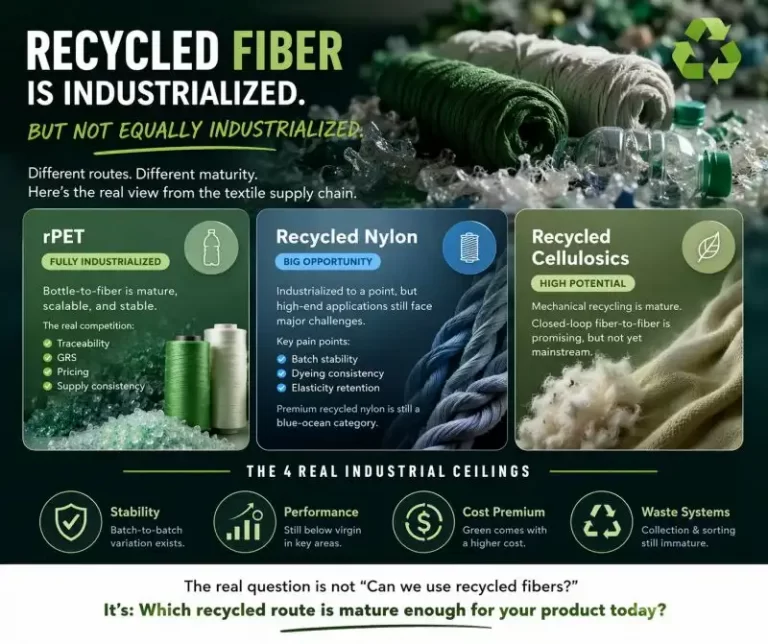
- recycled polyester
- recycled nylon
- recycled cotton
- circular yarn systems
- textile take-back programs
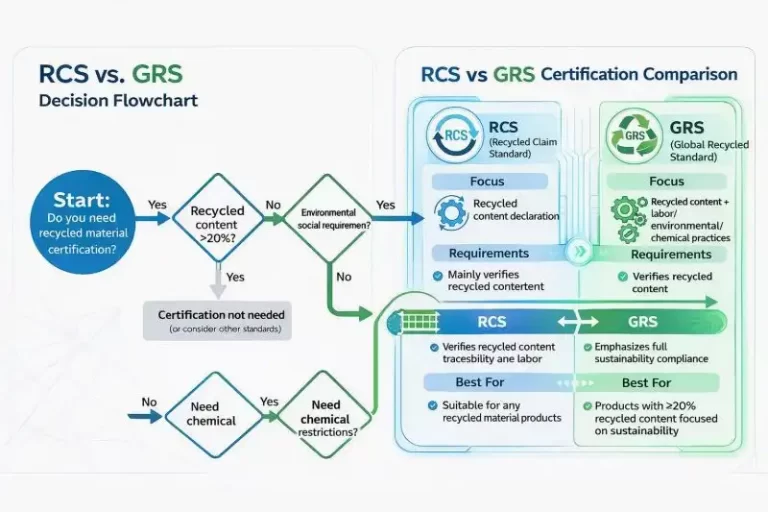
GRS Certification
Best for:
- export suppliers
- recycled polyester apparel
- sustainable activewear
- global brand supply chains
Key requirement:
recycled content ≧ 20%
Advantages:
- full supply chain traceability
- stronger brand trust
- ESG reporting support
- higher pricing power
RCS Certification
Best for:
- entry-level recycled product claims
- faster market access
- startup brands
- trim and accessory suppliers
Key requirement:
recycled content ≧ 5%
MMS (Emerging Standard)
MMS is expected to become increasingly relevant after 2027 as textile circularity regulations evolve.
Factories should begin monitoring:
- traceability workflows
- material data capture
- digital product passport compatibility
4. Green Factory Certification: Building System-Level Competitiveness
Green Factory certification evaluates the overall sustainability performance of a textile facility.
Six Core Evaluation DImensions
Infrastructure
- energy-saving buildings
- HVAC optimization
- lighting efficiency
Energy Consumption
- energy use per unit output
- clean energy integration
Water Management
- water reuse ratio
- dyeing wastewater optimization
Emission Control
- wastewater discharge
- VOC management
- air emission compliance
Solid Waste
- waste recycling utilization rate
- scrap reuse
Performance KPIs
- carbon intensity
- cleaner production score
- ESG readiness
Commercial value
Government incentives
Special grants, tax benefits, and policy support.
Brand trust
Many international brands prioritize Green Factory suppliers.
Financing advantages
Better access to green loans and lower financing costs.
5. Best Certification Strategy for Textile Companies
For export-focused textile suppliers
ISO 14067 + GRS
For domestic brand suppliers
Green Factory + GRS / RCS
For factories entering sustainability
Start with RCS
For cotton-based sustainable products
OCS + carbon footprint
6. 3-Step Circular Certification Roadmap
Step 1: Start Immediately
- identify high-emission processes
- audit recycled material ratio
- establish textile waste records
- map supply chain traceability gaps
Step 2: 2026-2027 System Building
- baseline carbon footprint calculation
- complete GRS or RCS
- self-assess Green Factory readiness
- build internal waste recycling systems
Step 3: 2027-2028 Competitive Upgrade
- align with textile carbon footprint standards
- build digital product passport readiness
- implement digital traceability systems
- integrate ESG disclosure workflows
Conclusion: Circular Certifications Are No Longer Optional
In 2026 and beyond, the textile industry is entering a new phase where:
carbon footprint + recycled materials + green factory
are no longer “bonus points.”
They are becoming the minimum qualification to remain in the global textile supply chain.
Factories that act early will gain:
- stronger brand trust
- higher margin opportunities
- export resilience
- better ESG positioning
- long-term strategic competitiveness